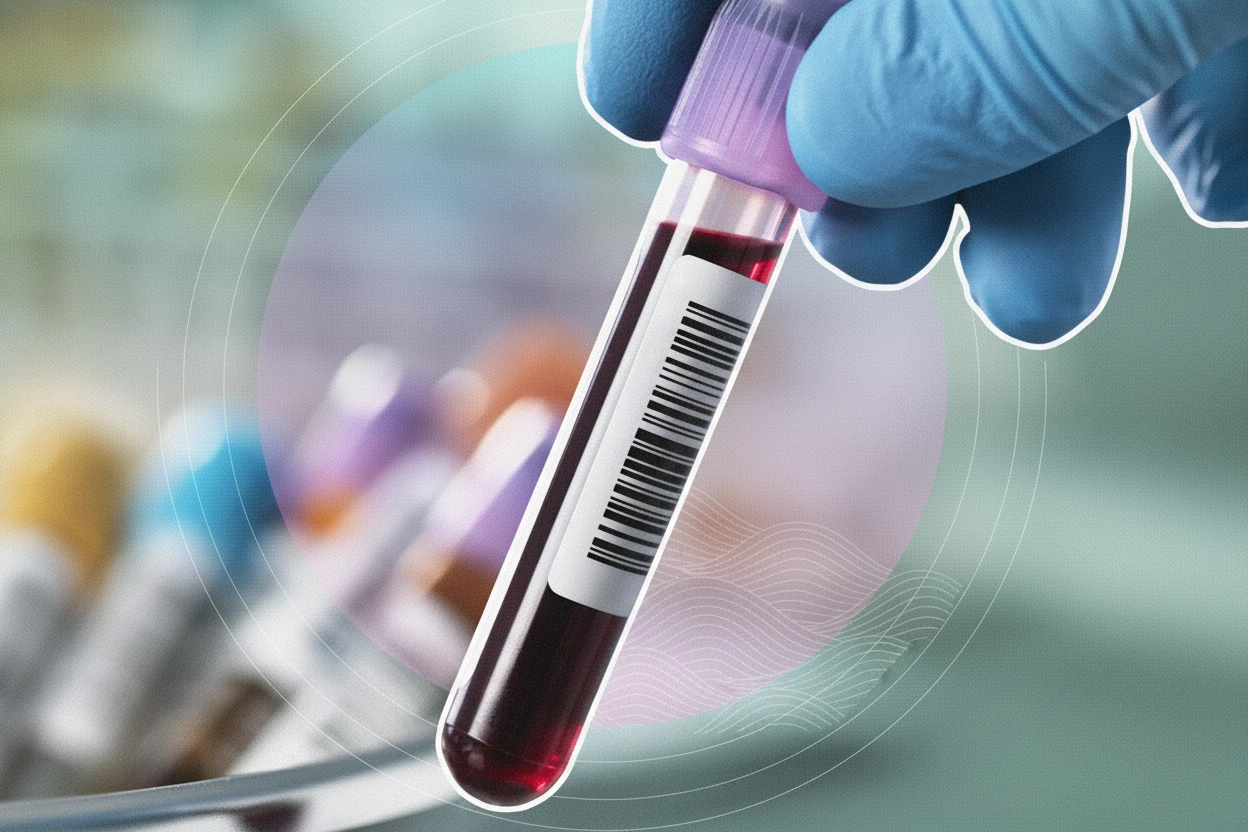
Blood clots can lead to serious health problems such as deep vein thrombosis (DVT) and pulmonary embolism (PE), which require prompt diagnosis and treatment1. The D-dimer test is a blood test that measures protein fragments produced when blood clots break down, helping healthcare providers detect or rule out clotting disorders quickly2. Because D-dimer levels rise when clots form and dissolve, this test is especially useful in emergency settings to guide further diagnostic steps3.
D-Dimer Test Purpose
D-dimer is a soluble fibrin degradation product generated when plasmin breaks down cross-linked fibrin clots4. It serves as a sensitive biomarker for thrombotic disorders, including acute pulmonary embolism (PE) and deep vein thrombosis (DVT)1. The test is widely used to rule out venous thromboembolism (VTE) and to evaluate the risk of VTE recurrence4.
The formation of D-dimer begins with thrombin converting fibrinogen into fibrin monomers, which polymerize and form clots. Subsequent fibrinolytic activity involving plasmin degrades these clots, releasing D-dimer fragments into the bloodstream5. Elevated D-dimer levels indicate ongoing clot formation and breakdown, which can occur in conditions such as VTE and acute aortic syndromes6.
However, D-dimer levels can also be elevated due to non-thrombotic causes, including infection, inflammation, cancer, pregnancy, aging, and strenuous physical activity, which limits the test’s specificity46. For example, D-dimer is a key biomarker for severity and mortality in COVID-19 and is associated with thrombotic events in these patients7.
“D-dimer is a byproduct of the blood clotting and breakdown process, serving as a marker of ongoing coagulation and fibrinolysis.”
— Robert B. Killeen, University of Illinois3
In clinical practice, a negative D-dimer test combined with a low clinical probability effectively excludes VTE, reducing the need for unnecessary imaging and improving patient management89. Serial D-dimer measurements can also monitor response to anticoagulant therapy, where decreasing levels are associated with better outcomes10.
Key uses of the D-dimer test include:
- Ruling out deep vein thrombosis (DVT) and pulmonary embolism (PE) in low-risk patients4
- Evaluating the risk of VTE recurrence and guiding anticoagulant therapy duration4
- Diagnosing and monitoring disseminated intravascular coagulation (DIC)3
- Assessing severity and prognosis in COVID-19 and other infections710
- Supporting evaluation of cryptogenic stroke for underlying malignancy or hypercoagulability3
How the D-Dimer Test Works
The D-dimer test is a blood test that detects D-dimer protein fragments in the blood, indicating clot formation and breakdown2. It is performed by drawing blood from a vein, usually in the arm, and analyzing the sample in a laboratory14.
Before the Test
No special preparation is required for a D-dimer test14. Patients can eat and drink normally unless otherwise instructed by their healthcare provider14. It is helpful to know what to expect to reduce anxiety and ensure a smooth experience14.
If the test is ordered by a healthcare provider, patients may receive a bloodwork requisition form with their personal and provider information and the specific test requested14.
During the Test
A trained phlebotomist or healthcare provider will perform the blood draw, which involves the following steps14:
- Cleaning a small area on the inside bend of the elbow with disinfectant14
- Wrapping an elastic band around the upper arm to make veins swell with blood14
- Inserting a needle into a vein to collect the blood sample14
- Removing the needle and applying pressure to the puncture site to stop bleeding14
The procedure is quick and generally well-tolerated, with minimal discomfort for most patients14. Rapid D-dimer assays are now available, allowing quick results in emergency settings11.
After the Test
After the blood draw, patients can resume normal activities immediately14. Results are typically available within a few hours to two days, depending on the laboratory and testing method14. The healthcare provider will review the results and discuss any necessary follow-up or additional testing14.
The D-dimer test is a simple blood test that can be performed quickly in hospitals, clinics, or laboratories. It helps healthcare providers rapidly assess the likelihood of blood clots, especially in emergency situations.112
Test Risks and Precautions
The D-dimer test carries the same risks as any routine blood draw, which are generally minimal and well-tolerated14. Possible side effects include:
- Minor pain or soreness at the needle site14
- Small bruising around the puncture area14
- Rarely, infection at the puncture site14
- Lightheadedness or nausea during or after the blood draw14
If a patient feels dizzy or unwell during the procedure, they should inform the healthcare provider immediately14. Serious complications are extremely uncommon14.
Preparing for Your D-Dimer Test
Where To Go
The D-dimer test can be performed in various healthcare settings, including a healthcare provider’s office, hospital, urgent care center, diagnostic laboratory, or clinic14. The location depends on the provider’s equipment and patient needs14.
What To Tell Your Provider
Before the test, inform your healthcare provider about all medications, supplements, and over-the-counter drugs you are taking, as some can affect D-dimer levels14. Anticoagulant medications, for example, may alter test results and influence interpretation14.
Also, share your medical history, including any recent surgeries, infections, or conditions that might affect clotting14.
What to Wear and Bring to the Test
Wear comfortable clothing with sleeves that can be easily rolled up or removed to allow access to your arm for the blood draw14. You may need to remove jewelry or accessories around your arm14.
Bring your insurance card and any paperwork, such as a requisition or referral form from your healthcare provider14. It can also be helpful to bring a list of your current medications and relevant medical history14.
If you have a fear of needles or feel anxious, consider bringing a friend or family member for support. Depending on the facility’s policy, they may be allowed to accompany you during the blood draw14.
How Much The Test Costs
Cost information for the D-dimer test varies depending on the healthcare setting, insurance coverage, and location. Patients should check with their healthcare provider or insurance company for specific cost details.
Understanding D-Dimer Results
Interpreting Your Results
D-dimer test results are usually reported in milligrams per liter (mg/L) or nanograms per milliliter (ng/mL), with normal values generally considered less than 0.50 mg/L (or 500 ng/mL)143.
- Normal or Negative Result: Indicates low levels of D-dimer, making the presence of an active blood clot or clotting disorder unlikely23.
- Elevated or Positive Result: Suggests increased clot formation and breakdown, which may indicate a blood clotting condition such as DVT, PE, disseminated intravascular coagulation (DIC), or stroke23.
Because D-dimer is highly sensitive but not specific, a positive result does not confirm the presence or location of a clot. Further diagnostic imaging, such as ultrasound, venography, or CT scans, is often needed to identify and locate clots14.
Elevated D-dimer levels can also occur in other conditions, including pregnancy, recent surgery, trauma, infection, cancer, inflammation, liver disease, and aging4312. Therefore, results must be interpreted in the context of the patient’s clinical presentation and risk factors3.
Inaccurate Results
“A D-dimer test measures protein fragments released when a blood clot dissolves, helping healthcare providers detect clotting disorders quickly and guide further testing.2”
False-positive results may occur due to factors such as inflammation, infection, pregnancy, malignancy, or recent surgery43. False negatives can happen if the blood sample is taken too early during clot formation or if the patient is on anticoagulant therapy3.
Variations in testing methods, laboratory standards, and patient factors can also affect accuracy14. Emerging research supports using age-adjusted cutoff values to improve specificity, especially in older patients3.
| Result Type | D-Dimer Level (mg/L) | Meaning |
|---|---|---|
| Normal/Negative | < 0.50 | Blood clot unlikely |
| Elevated/Positive | ≥ 0.50 | Possible blood clot; further testing needed |
D-Dimer Test Summary
The D-dimer test is a valuable, simple blood test used primarily to rule out serious blood clotting conditions such as deep vein thrombosis and pulmonary embolism14. It measures protein fragments released when blood clots dissolve, providing a sensitive marker of clot formation and breakdown42.
The test requires no special preparation and involves a routine blood draw, with minimal risks and side effects14. Results are typically available within hours to a couple of days and must be interpreted alongside clinical evaluation and other diagnostic tests14.
While a negative D-dimer test can effectively exclude clotting disorders in low-risk patients, elevated levels require further investigation due to the test’s low specificity and potential for false positives843. The test also has applications in monitoring treatment response and assessing prognosis in conditions like COVID-19 and disseminated intravascular coagulation107.