Sleep apnea affects nearly one billion adults worldwide, with obstructive sleep apnea (OSA) being the most common form. Untreated OSA can lead to serious health problems such as high blood pressure, heart disease, and stroke1 . Fortunately, various devices are available to help maintain open airways during sleep and improve breathing quality2 . These devices range from positive airway pressure machines to oral appliances and implantable stimulators, each tailored to different types and severities of sleep apnea3 .
How Sleep Apnea Devices Work
Sleep apnea causes repeated interruptions in breathing during sleep, primarily due to airway collapse or failure of the brain to signal breathing muscles. Obstructive sleep apnea (OSA) occurs when the upper airway collapses, blocking airflow3 . Central sleep apnea (CSA), less common, results from the brain’s failure to generate normal respiratory effort, not airway obstruction3 . Devices for sleep apnea work by maintaining airway patency or stimulating respiratory muscles to prevent breathing pauses.
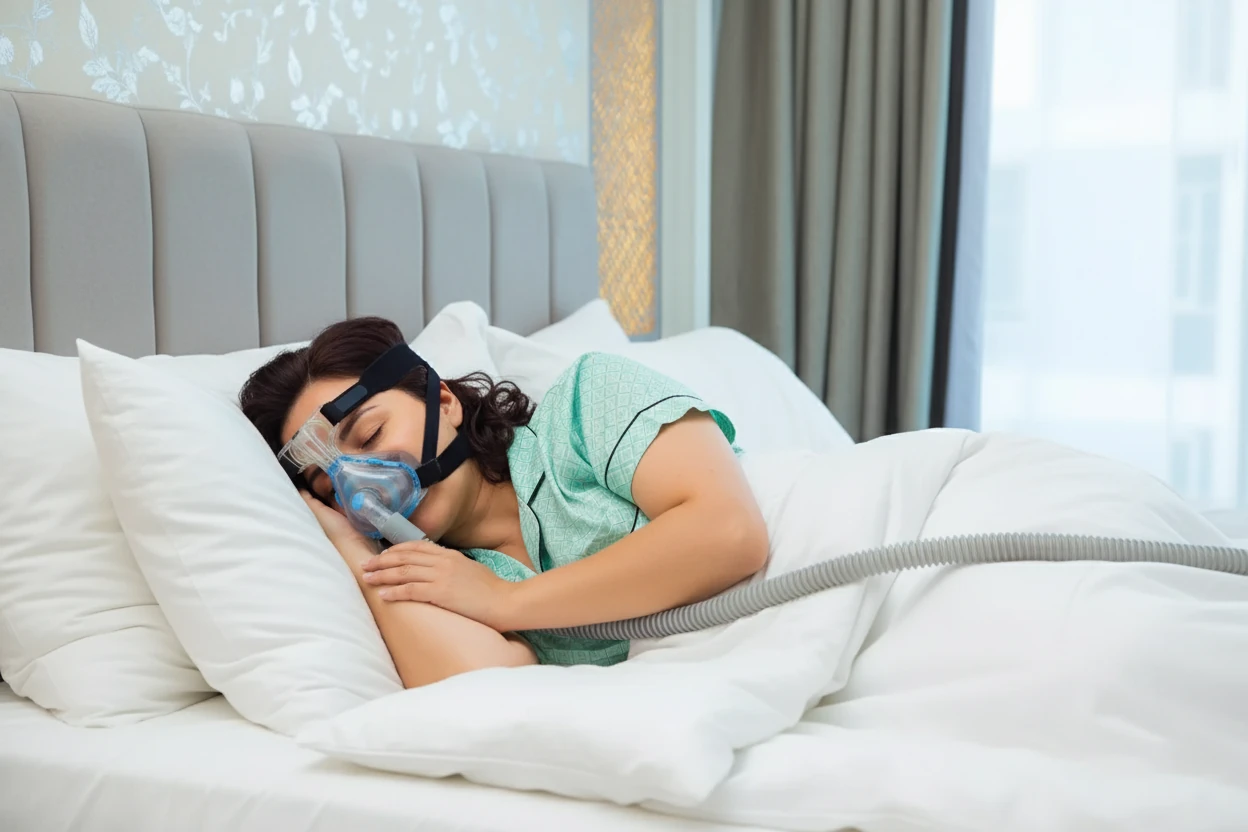
Positive airway pressure (PAP) devices are the main treatment for both OSA and CSA. They deliver pressurized air through a mask to keep the airway open, preventing collapse and apnea events3 . PAP machines use algorithms to adjust pressure, detect apnea events, and compensate for air leaks, with variations depending on the device model4 . Oral appliances mechanically prevent airway collapse by advancing the lower jaw or retaining the tongue forward, increasing airway space5 . Emerging wearable artificial intelligence (AI) devices offer real-time monitoring of respiratory events during sleep, showing a pooled accuracy of 89.3% in detecting apnea episodes6 .
Types of Sleep Apnea Devices
Positive Airway Pressure (PAP) Machines
PAP therapy is the most common and reliable method for treating sleep apnea7 . It involves delivering pressurized air through a nasal, oral, or combined mask to keep the airway open during sleep3 . There are several types of PAP devices:
- Continuous Positive Airway Pressure (CPAP): Provides a constant, steady air pressure to stent the airway open3 .
- Automatic Positive Airway Pressure (APAP): Automatically adjusts air pressure throughout the night based on detected respiratory events3 .
- Bilevel Positive Airway Pressure (BiPAP): Delivers higher pressure during inhalation and lower pressure during exhalation, useful for patients with other breathing problems or CPAP intolerance3 .
- Expiratory Positive Airway Pressure (EPAP): Uses a valve over the nostrils to create resistance during exhalation, helping keep the airway open8 .
- Adaptive Servo-Ventilation (ASV): Monitors breathing in real-time and adjusts pressure support breath-by-breath, mainly used for central sleep apnea8 .
PAP devices collect data on compliance, pressure, leaks, and efficacy, allowing clinicians to monitor and adjust therapy remotely4 . Proper mask fitting and individualized pressure titration improve comfort and adherence3 .
Oral Appliances
Oral appliances are dental devices designed to keep the airway open by repositioning the jaw or tongue during sleep. They are primarily recommended for mild-to-moderate OSA or for patients intolerant to PAP therapy5 . The main types include:
- Mandibular Advancement Devices (MADs): These pull the lower jaw forward, increasing airway space and preventing collapse5 9.
- Tongue Retaining Devices (TRDs): These hold the tongue forward using suction to prevent airway obstruction5 9.
Custom-made, titratable MADs are preferred over fixed devices, especially for moderate OSA, as they allow adjustment for better efficacy and comfort10 . Oral appliances improve symptoms and reduce apnea-hypopnea index (AHI) compared to no treatment in mild cases5 . Side effects can include jaw pain, dry mouth, salivation, gum irritation, and long-term dental changes such as bite alteration11 9. The success rate of oral appliances in reducing AHI to less than 10 is about 54% 12.
Stimulation Devices
Hypoglossal nerve stimulation is an implantable therapy approved by the FDA for select patients who are intolerant to PAP therapy3 . The device stimulates the hypoglossal nerve during sleep, preventing the tongue and soft tissues from blocking the airway13 . Inspire therapy is a well-known example, providing a mask-free solution with reported 79% reduction in sleep apnea events and high patient satisfaction13 . It is also FDA-approved for pediatric patients with Down Syndrome13 . Surgical implantation is required, and patient selection is critical for success3 .
Positional Therapy Devices
Positional therapy devices help patients avoid sleeping on their back, a position that often worsens OSA. These devices encourage side sleeping, which can reduce AHI by 56–75% in patients with position-dependent OSA14 . Positional therapy can be used alone or in combination with PAP therapy for enhanced benefit14 .
Effectiveness of Sleep Apnea Devices
The effectiveness of sleep apnea devices depends on the type and severity of the disorder, as well as patient adherence. PAP therapy remains the gold standard, especially for moderate-to-severe OSA, due to its superior efficacy in preventing airway collapse3 15. Systematic reviews confirm that PAP therapy reduces daytime sleepiness, lowers blood pressure, and decreases cardiovascular risk3 16. However, CPAP adherence is often limited by discomfort from masks and pressure settings3 .
Oral appliances are effective alternatives for mild-to-moderate OSA and for patients who cannot tolerate PAP therapy5 . Meta-analyses show MADs reduce AHI by an average of 19.1 events per hour in East Asian populations, with improvements in oxygen saturation and blood pressure17 . Adjustable MADs demonstrate greater efficacy in moderate-to-severe cases compared to fixed devices10 . Long-term use maintains efficacy but may cause dental side effects11 .
Hypoglossal nerve stimulation offers significant AHI reductions (≥50%) in PAP-intolerant patients and high satisfaction rates3 13. Positional therapy effectively reduces AHI in position-dependent OSA patients and can be combined with PAP for better outcomes14 .
“The research was conducted in small groups of people. Despite these limitations, studies showed improvements in 75% and 83% of patients, compared to nearly 95% with CPAP.”
— Hrayr Attarian, Northwestern University Feinberg School of Medicine1
Using Your Sleep Apnea Device
Effective use of sleep apnea devices requires proper fitting, patient education, and regular follow-up. CPAP therapy is the first-line treatment for OSA but often faces challenges with adherence due to mask discomfort, nasal dryness, or claustrophobia3 2. Oral appliances tend to be better tolerated, especially in mild-to-moderate cases, but are less effective for severe OSA18 .
Positional therapy devices are simple to use and effective for patients with position-dependent OSA, reducing apnea events when sleeping on the side14 . Hypoglossal nerve stimulators require surgical implantation and are used in patients who cannot tolerate PAP therapy3 .
Regular follow-up is essential to assess device efficacy, side effects, and the need for adjustments. Telehealth platforms are increasingly used for remote monitoring and mandibular advancement device titration, improving access and adherence18 .
- Ensure proper mask fitting to reduce leaks and improve comfort3 .
- Follow clinician guidance for pressure settings and device adjustments3 .
- Use trial oral appliances to identify responders before investing in custom devices19 .
- Maintain regular follow-up appointments for monitoring and troubleshooting4 .
- Combine therapies, such as PAP and positional therapy, if recommended by your provider14 .
“There has always been interest in CPAP alternatives. These numbers increase as more patients receive the diagnosis, while the absolute number of people intolerant to CPAP grows accordingly. Meanwhile, the dropout rate is decreasing due to improvements in CPAP and mask technology.”
— Johan Verbraecken, Antwerp University Hospital1
Choosing a Sleep Apnea Device
Selecting the right device depends on the type and severity of sleep apnea, patient tolerance, and lifestyle factors. Accurate diagnosis through sleep studies, including nocturnal polysomnography or home sleep tests, is crucial to guide therapy choice7 .
Key considerations include:
- Severity of apnea: CPAP is preferred for moderate-to-severe OSA, while oral appliances suit mild-to-moderate cases3 15.
- Patient tolerance: Oral appliances and positional therapy may be better tolerated by some patients18 .
- Underlying apnea type: PAP devices treat both obstructive and central sleep apnea, while oral appliances are not suitable for central apnea3 9.
- Lifestyle and convenience: Oral appliances are portable and convenient for travel9 .
- Medical comorbidities: Hypoglossal nerve stimulation may be an option for PAP-intolerant patients3 .
Trial use of oral appliances can help identify responders before committing to custom devices19 . Clinician guidance is essential to ensure safe and effective use of any device3 .
💡 Did You Know?
CPAP machines are the best bet for moderate to severe sleep apnea cases. Oral appliances are another option for sleep apnea treatment. 15
Sleep Apnea Device Summary
Sleep apnea devices have evolved to offer personalized treatment options tailored to individual patient needs. PAP therapy remains the gold standard for moderate-to-severe OSA due to its high efficacy in preventing airway collapse and reducing health risks3 1. Oral appliances provide a valuable alternative for mild-to-moderate OSA or PAP-intolerant patients, improving symptoms and quality of life5 9. Implantable hypoglossal nerve stimulators and positional therapy devices expand options for select patients.
Key factors for successful treatment include accurate diagnosis, proper device fitting, patient education, and regular follow-up to monitor efficacy and manage side effects. Emerging technologies such as smart mandibular advancement devices and wearable AI monitors promise further personalization and improved adherence in the future6 20.
- Device efficacy varies by patient phenotype, severity, and adherence21 .
- Treatment is moving toward individualized approaches rather than one-size-fits-all21 .
- Clinician consultation is critical to optimize device selection and therapy outcomes3 .
- Alternative therapies should be considered if initial treatment fails3 .