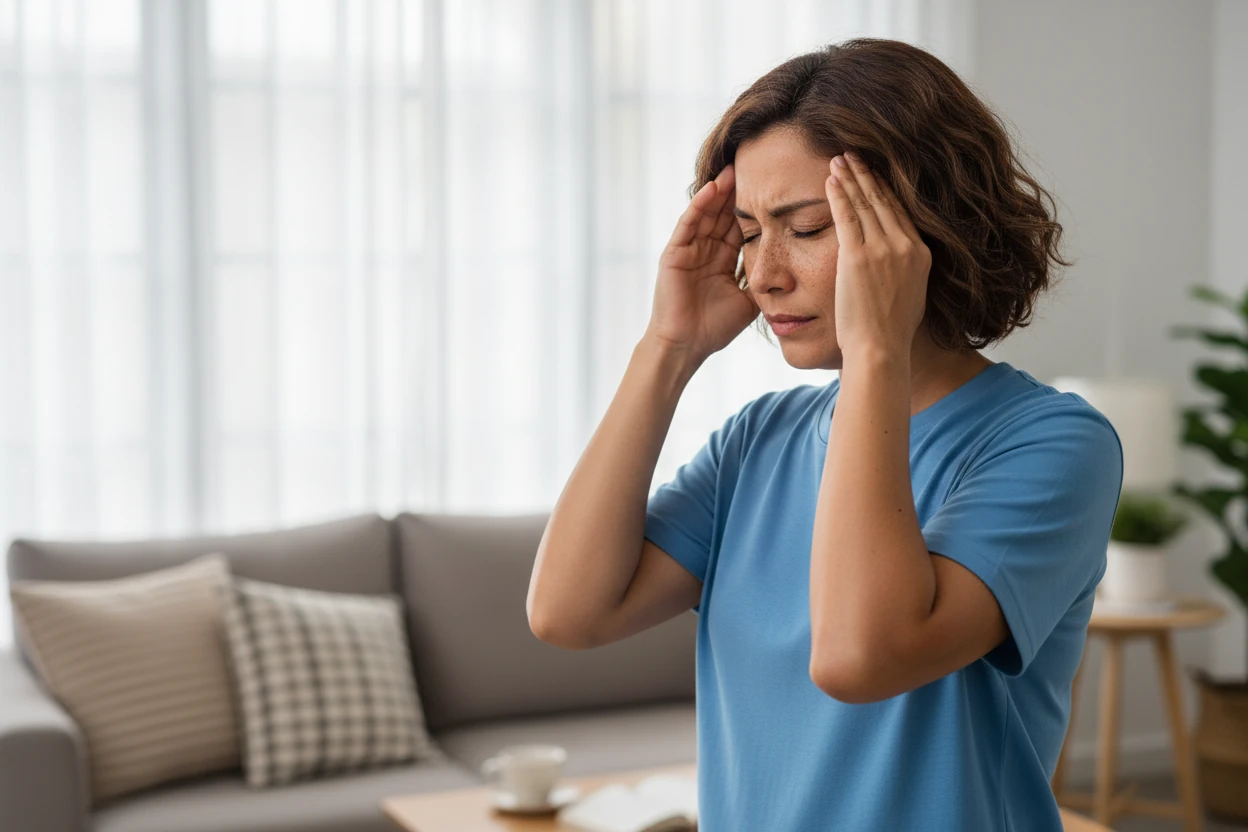
Headaches are one of the most common health complaints worldwide, affecting nearly everyone at some point in their lives1. They can vary greatly in type, severity, location, and frequency, often causing significant disruption to daily activities and quality of life1. Understanding the different headache types and their symptoms is essential for proper diagnosis and treatment2.
Common Headache Symptoms
Headache pain is the predominant symptom across most headache disorders, ranging from mild discomfort to severe pain3. The pain can be diffuse or localized, affecting areas such as the temples, behind the eyes, or one side of the head3. Many headaches also involve referred pain or aching in the neck and shoulder muscles, often due to muscular tension or nerve referral43. Associated symptoms beyond pain may include nausea, vomiting, and heightened sensitivity to light and sound56.
Headache pain is typically described as pressure, throbbing, constant, sharp, or dull, and can differ greatly in severity and duration1. While most headaches are not dangerous, some types may signal serious underlying conditions requiring urgent medical attention1. Common triggers for primary headaches include alcohol (especially red wine), certain foods containing nitrates, nicotine, changes in sleep patterns, poor posture, physical activity, and emotional stress1.
- Headache pain can be localized or diffuse, often involving the temples, behind the eyes, or unilateral areas3.
- Neck and shoulder muscle tenderness frequently accompany headaches due to musculoskeletal involvement4.
- Associated symptoms may include nausea, vomiting, photophobia (light sensitivity), and phonophobia (sound sensitivity)56.
- Primary headaches are caused by dysfunction or overactivity of pain-sensitive structures in the head, not by other medical conditions1.
- Secondary headaches arise from underlying medical issues and may require specific treatment1.
Migraine Headache Signs
migraine-relief-16-effective-treatment-optionsmigraine-prodrome-symptoms-and-feelingsmigraine-relief-16-effective-treatment-optionsMigraine is a genetically influenced complex neurological disorder characterized by episodes of moderate-to-severe headaches, typically unilateral and frequently accompanied by nausea and heightened sensitivity to light and sound7. Affecting about 15-20% of the global population, migraine is a major cause of disability and loss of productivity87.
Migraine attacks usually last between 4 and 72 hours if untreated and progress through four distinct phases: prodrome, aura, headache, and postdrome9107. The prodrome phase, experienced by approximately 77% of patients, includes symptoms such as yawning, mood changes, neck stiffness, and sensitivity to light and sound7. Aura occurs in about 25% of migraine sufferers and involves fully reversible neurological symptoms like visual disturbances, sensory changes, or speech difficulties7.
The headache phase is often unilateral with a pulsatile or throbbing quality, accompanied by nausea, vomiting, photophobia, and phonophobia67. Functional impairment during migraine can be profound, with many patients seeking relief in dark, quiet environments57. The postdrome phase includes symptoms like exhaustion, dizziness, and difficulty concentrating7.
- Migraine headaches are typically moderate to severe, unilateral, and pulsating97.
- Attacks last from 4 to 72 hours if untreated98.
- Common associated symptoms include nausea, vomiting, photophobia, and phonophobia67.
- Migraine has a strong genetic component, with increased risk if one or both parents have migraines7.
- Migraine phases include prodrome, aura, headache, and postdrome, each with distinct symptoms9107.
“Migraine is a genetically influenced complex neurological disorder characterized by episodes of moderate-to-severe headaches, typically unilateral and frequently accompanied by nausea and heightened sensitivity to light and sound.”
— Marco A. Pescador Ruschel, Medical Center Santa Rita7
Tension Headache Signs
Tension-type headaches are the most common primary headache disorder, usually causing mild to moderate bilateral head pain113. The pain is often described as a dull, pressing sensation or a tight band around the head rather than throbbing113. These headaches are less disabling than migraines and tend to have shorter duration113.
Muscle tenderness and pain in the neck and shoulders are frequent accompanying symptoms, reflecting the role of musculoskeletal factors in tension headaches43. Stress and muscle tension are common triggers12. Unlike migraines, tension headaches usually do not cause nausea, vomiting, or sensitivity to light and sound12.
- Tension headaches typically involve bilateral, dull, pressing pain113.
- Pain often affects the temporal regions and may feel like tightness or pressure encircling the head113.
- Neck and shoulder muscle tenderness commonly accompany tension headaches43.
- These headaches are usually mild to moderate in intensity and less disabling than migraines113.
- Stress and muscle tension are common contributing factors12.
Cluster Headache Symptoms
Cluster headaches are a form of trigeminal autonomic cephalalgia characterized by sudden onset of severe unilateral head pain lasting from 15 minutes to 3 hours1311. The pain is sharp, stabbing, and excruciating, often described as more intense than tension headaches but sometimes less disabling than migraines113.
Cluster headaches are accompanied by ipsilateral autonomic symptoms such as tearing (lacrimation), nasal congestion, eyelid drooping (ptosis), sweating, and facial flushing13113. These headaches often follow a circadian pattern and may be triggered by alcohol consumption1311.
- Cluster headaches cause severe, unilateral, sharp or stabbing pain lasting 15 minutes to 3 hours113.
- Autonomic symptoms on the same side as the pain include tearing, nasal congestion, ptosis, and sweating1311.
- These headaches begin abruptly and can be extremely intense113.
- Cluster headaches are less common than migraine or tension headaches but are notable for their severity and pattern14.
- Alcohol is a known trigger for cluster headache attacks13.
Cluster headaches are among the most painful types of headaches, often described as stabbing or burning sensations around one eye. The accompanying autonomic symptoms help distinguish them from other headache types1113.
Headache Symptoms in Children
Headaches are common in children and adolescents, with up to 75% of those aged 10 to 18 experiencing at least one headache annually1516. The symptom profile in children largely mirrors that of adults, except for abdominal migraine, a pediatric migraine variant characterized primarily by gastrointestinal symptoms rather than head pain1718.
Abdominal migraine presents with recurrent abdominal pain, nausea, anorexia, and sensitivity to light or sound but often lacks the typical headache pain seen in classic migraine1718. A family history of migraine increases the likelihood of abdominal migraine in children, who may later develop typical migraine headaches1718.
- Headache symptoms in children are similar to those in adults1615.
- Approximately 75% of children aged 10 to 18 report headaches annually1516.
- Abdominal migraine is a childhood-specific variant with gastrointestinal symptoms instead of headache pain1718.
- Symptoms of abdominal migraine include recurrent abdominal pain, nausea, anorexia, photophobia, and phonophobia1718.
- Family history of migraine increases the risk of abdominal migraine and later classic migraine1718.
When to See a Doctor for Headache Symptoms
Medical evaluation is recommended when headaches increase in frequency, severity, or become resistant to treatment319. Referral to a neurologist is advised if secondary causes or complex headache disorders are suspected319. Headaches that disrupt daily activities or require frequent medication use also warrant professional assessment319.
Emergency medical care is necessary for headaches with sudden onset of severe pain (thunderclap headache), neurological symptoms, fever, visual changes, or following head trauma31920. These may indicate serious conditions such as stroke, infection, or raised intracranial pressure212.
- Seek medical advice if headaches become more frequent, severe, or resistant to treatment319.
- Headaches accompanied by neurological symptoms like weakness, numbness, or speech difficulties require urgent evaluation319.
- Sudden, severe headaches or the "worst headache ever" need emergency care319.
- Headaches with fever, stiff neck, rash, or confusion may indicate infection and require prompt attention319.
- Frequent headaches interfering with daily life or needing daily medication should be evaluated by a healthcare provider319.
If you experience a sudden, severe headache or neurological symptoms such as weakness or vision changes, seek emergency medical care immediately. Early diagnosis can be life-saving20.
Headache Symptoms Summary
Headaches fall into three primary categories: migraine, tension-type, and cluster headaches, each with distinct symptom profiles2. Migraine is often the most disabling, featuring unilateral, pulsatile pain with nausea and sensory sensitivities113. Tension headaches are the most common and usually cause bilateral, dull, pressing pain with muscle tenderness113. Cluster headaches are less common but extremely painful, characterized by sharp unilateral pain and autonomic symptoms113.
Anyone who has dealt with a migraine attack can tell you that they would do almost anything never to experience that kind of pain again. This highlights the severe impact migraines can have on quality of life22.
All headache types can significantly impact daily functioning and quality of life113. Early recognition and accurate diagnosis are crucial for effective management and improved outcomes143. Associated symptoms such as nausea, photophobia, and neck or shoulder pain help differentiate headache types and guide treatment546.
| Headache Type | Pain Location | Pain Quality | Duration | Associated Symptoms |
|---|---|---|---|---|
| Migraine | Usually unilateral | Pulsatile, throbbing | 4 to 72 hours | Nausea, vomiting, photophobia, phonophobia97 |
| Tension-type | Bilateral | Dull, pressing | Variable, shorter | Neck and shoulder muscle tenderness114 |
| Cluster | Unilateral (around eye) | Sharp, stabbing | 15 min to 3 hours | Ipsilateral tearing, nasal congestion, ptosis1311 |
| Sources:12345678910111213141516171819202122 | ||||
- Headache pain often involves adjacent areas such as the neck and shoulders43.
- Symptoms beyond pain include nausea, vomiting, photophobia, and phonophobia56.
- Accurate symptom identification is key to diagnosis and management319.
- Headaches can be triggered by lifestyle factors like stress, sleep changes, and diet1.
- Treatment depends on headache type, frequency, and severity1.