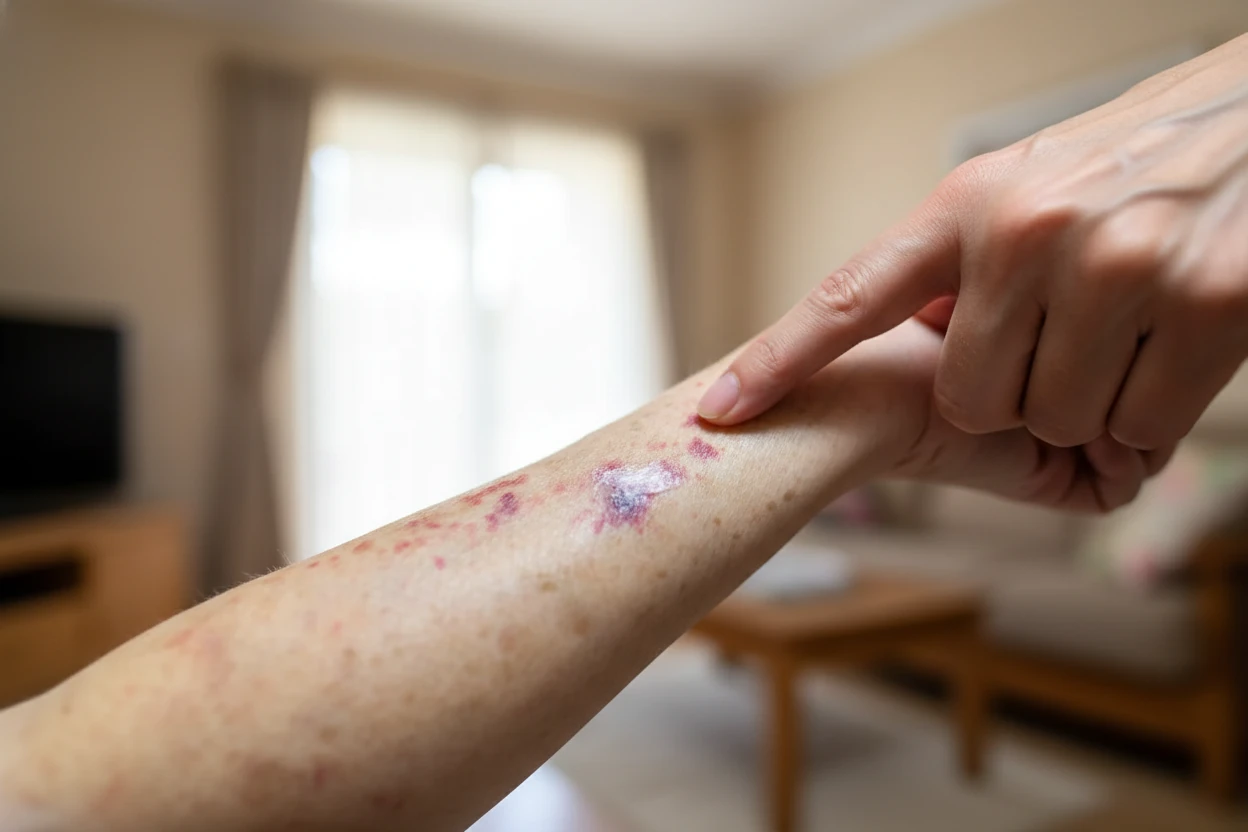
CREST syndrome, also known as limited cutaneous systemic sclerosis, is a rare autoimmune condition affecting approximately 19 people per million, primarily women aged 30 to 50 years12. It causes hardening and tightening of the skin and connective tissues, often progressing slowly with milder internal organ involvement compared to other forms of systemic sclerosis32. Although incurable, early diagnosis and multidisciplinary management can improve quality of life and reduce complications45.
Symptoms of CREST Syndrome
CREST syndrome is defined by the presence of at least three of five key clinical features: calcinosis, Raynaud's phenomenon, esophageal dysmotility, sclerodactyly, and telangiectasia67. Symptoms vary depending on the affected tissues and organs.
Skin Symptoms
Skin changes are often the earliest and most visible signs of CREST syndrome. These include:
- Skin thickening and tightening: The skin becomes hard, shiny, and less flexible, especially on the fingers and toes, a condition known as sclerodactyly189.
- Calcinosis: Deposits of calcium salts form hard nodules under the skin, which can cause painful ulcerations if they break through the skin surface61011.
- Telangiectasias: Small dilated blood vessels appear as red spots, commonly on the face and hands1211.
- Discoloration and texture changes: The skin may appear discolored and feel tight, affecting appearance and mobility139.
These cutaneous manifestations reflect fibrosis and vascular abnormalities characteristic of CREST syndrome514.
Joint Symptoms
Joint involvement in CREST syndrome often presents as:
- Swelling and stiffness: Patients may experience joint pain, swelling, and stiffness, particularly in the hands and fingers1516.
- Limited joint mobility: Thickened skin and fibrosis can restrict finger movement, sometimes leading to claw-like deformities915.
- Muscle weakness and pain: Some individuals report muscle discomfort and weakness, contributing to functional impairment1517.
These symptoms may develop gradually and contribute to disability if untreated415.
Gastrointestinal Symptoms
Gastrointestinal (GI) involvement is common in CREST syndrome, affecting up to 90% of patients18. Key GI symptoms include:
- Esophageal dysmotility: The muscles of the esophagus lose function, causing difficulty swallowing and acid reflux61911.
- Gastroesophageal reflux disease (GERD): Acid reflux leads to heartburn and discomfort, often requiring treatment with proton pump inhibitors (PPIs)1918.
- Gastroparesis: Delayed stomach emptying can cause nausea, bloating, and weight loss20.
- Other GI symptoms: Bloating, diarrhea, constipation, and fecal incontinence may occur due to involvement of the small bowel and colon1918.
GI symptoms can significantly impact nutrition and quality of life1918.
Causes and Risk Factors
CREST syndrome is a subtype of systemic sclerosis, an autoimmune disease characterized by immune-mediated fibrosis and vascular dysfunction2114. The exact cause remains unclear but involves complex interactions between genetics, environmental exposures, and immune system abnormalities.
- Autoimmune process: The immune system attacks connective tissues, leading to endothelial injury, fibroblast activation, and excessive collagen deposition causing fibrosis2122.
- Genetic predisposition: Certain genetic loci increase susceptibility to systemic sclerosis and CREST syndrome23.
- Environmental triggers: Exposure to silica dust, organic solvents, and viral infections has been linked to increased risk23.
- Drug-induced causes: Some medications and substances, such as bleomycin and cocaine, can induce scleroderma-like syndromes23.
Risk Factors
Risk factors associated with CREST syndrome include:
- Female sex, with a female-to-male ratio of approximately 3:112.
- Age of onset typically between 30 and 50 years32.
- Occupational exposure to environmental agents like silica dust23.
- Genetic susceptibility and family history of autoimmune diseases23.
These factors contribute to disease development but do not guarantee onset23.
Diagnosis and Testing
Diagnosing CREST syndrome requires a thorough clinical evaluation due to overlapping features with other connective tissue diseases47. Key diagnostic steps include:
- Clinical history and physical exam: Assessment of skin thickening, telangiectasias, digital ulcers, and sclerodactyly41.
- Laboratory tests: Detection of antinuclear antibodies (ANA), especially anti-centromere antibodies, which are highly associated with CREST syndrome245.
- Nailfold capillaroscopy: Examines capillary changes such as pitting, characteristic of systemic sclerosis25.
- Organ function tests: Blood tests to evaluate liver and kidney function, lung function tests, and imaging studies to assess internal organ involvement418.
- Imaging: MRI, CT scans, or X-rays may be used to detect calcinosis and lung fibrosis41018.
Early diagnosis is vital for managing symptoms and preventing complications45.
Treatment Options for CREST
There is no cure for CREST syndrome; treatment focuses on symptom control, slowing disease progression, and preventing organ damage526. Management is multidisciplinary and individualized based on symptoms.
Medications
Pharmacologic therapies target specific manifestations:
- Immunosuppressants: Used to modulate the immune response and reduce fibrosis54.
- Corticosteroids: May be used cautiously to control inflammation4.
- Vasodilators: Calcium channel blockers improve blood flow and reduce Raynaud's phenomenon symptoms25.
- Proton pump inhibitors (PPIs): Manage gastroesophageal reflux and esophageal symptoms1918.
- Other agents: D-penicillamine, colchicine, and emerging therapies targeting fibrotic and vascular pathways are under investigation518.
Physical Therapy
Physical therapy plays a key role in maintaining function:
- Range-of-motion exercises: Help preserve joint mobility and reduce stiffness27.
- Strengthening exercises: Improve muscle function and overall physical capacity27.
- Assistive devices: May support daily activities and independence27.
- Tailored exercise programs: Enhance respiratory capacity and musculoskeletal health27.
These interventions complement pharmacologic treatment and improve quality of life274.
“The 2023 update of the EULAR recommendations for the treatment of systemic sclerosis emphasizes the importance of multidisciplinary care and patient education in managing systemic sclerosis, including CREST syndrome.18”
— EULAR (European League Against Rheumatism)
Prevention Strategies
Currently, there are no established preventive measures for CREST syndrome23. However, symptom management and lifestyle modifications are important to reduce severity and improve outcomes:
- Smoking cessation to improve vascular symptoms and reduce Raynaud's attacks25.
- Protection from cold exposure to prevent blood vessel spasms25.
- Regular skin care including moisturization and sun protection to reduce skin complications13.
- Nutritional support to manage gastrointestinal symptoms and maintain health19.
- Lifestyle changes such as meal timing to alleviate esophageal symptoms19.
These strategies support overall well-being and may slow disease progression425.
Related Health Conditions
CREST syndrome can overlap with other autoimmune diseases, complicating diagnosis and management:
- Overlap syndromes: Patients may exhibit features of systemic lupus erythematosus (SLE), rheumatoid arthritis (RA), or Sjögren's syndrome alongside CREST2819.
- Pulmonary arterial hypertension (PAH): A serious complication causing shortness of breath, chest discomfort, and fatigue, leading to increased morbidity29.
- Interstitial lung disease (ILD): Lung scarring that impairs breathing and may progress to respiratory failure30.
- Cardiac involvement: Arrhythmias and myocardial fibrosis can occur, affecting heart function31.
Monitoring and managing these conditions are essential parts of CREST syndrome care293031.
Living With CREST Syndrome
Living with CREST syndrome requires ongoing adaptation to chronic symptoms that affect daily function and quality of life4. Key considerations include:
- Early consultation with specialists improves diagnosis and management4.
- Adherence to treatment and lifestyle modifications is crucial for symptom control4.
- Multidisciplinary care addresses the diverse manifestations of the disease5.
- Disability eligibility depends on symptom severity and functional impairment4.
- Psychological support may be needed to cope with chronic illness challenges4.
“CREST syndrome is a form of systemic sclerosis (SSc), an autoimmune condition affecting connective tissues. It involves various systems in the body, with symptoms depending on the affected organs. CREST syndrome is a type of scleroderma characterized by slow progression and is generally considered a milder form with a better prognosis.16”
— American College of Rheumatology
Frequently Asked Questions
Can CREST syndrome be cured?
No, CREST syndrome is a chronic autoimmune disease with no known cure. Treatment focuses on managing symptoms and preventing complications526.
What are the main symptoms to watch for?
Key symptoms include skin thickening, Raynaud's phenomenon, calcium deposits under the skin, difficulty swallowing, and visible dilated blood vessels67.
Is CREST syndrome hereditary?
Genetic predisposition plays a role, but environmental factors and immune system dysfunction also contribute to disease development23.
How is CREST syndrome diagnosed?
Diagnosis involves clinical evaluation, blood tests for specific antibodies, nailfold capillaroscopy, and imaging to assess organ involvement424.
What lifestyle changes help manage CREST syndrome?
Avoiding cold exposure, quitting smoking, skin care, nutritional support, and tailored exercise programs improve symptoms and quality of life251927.