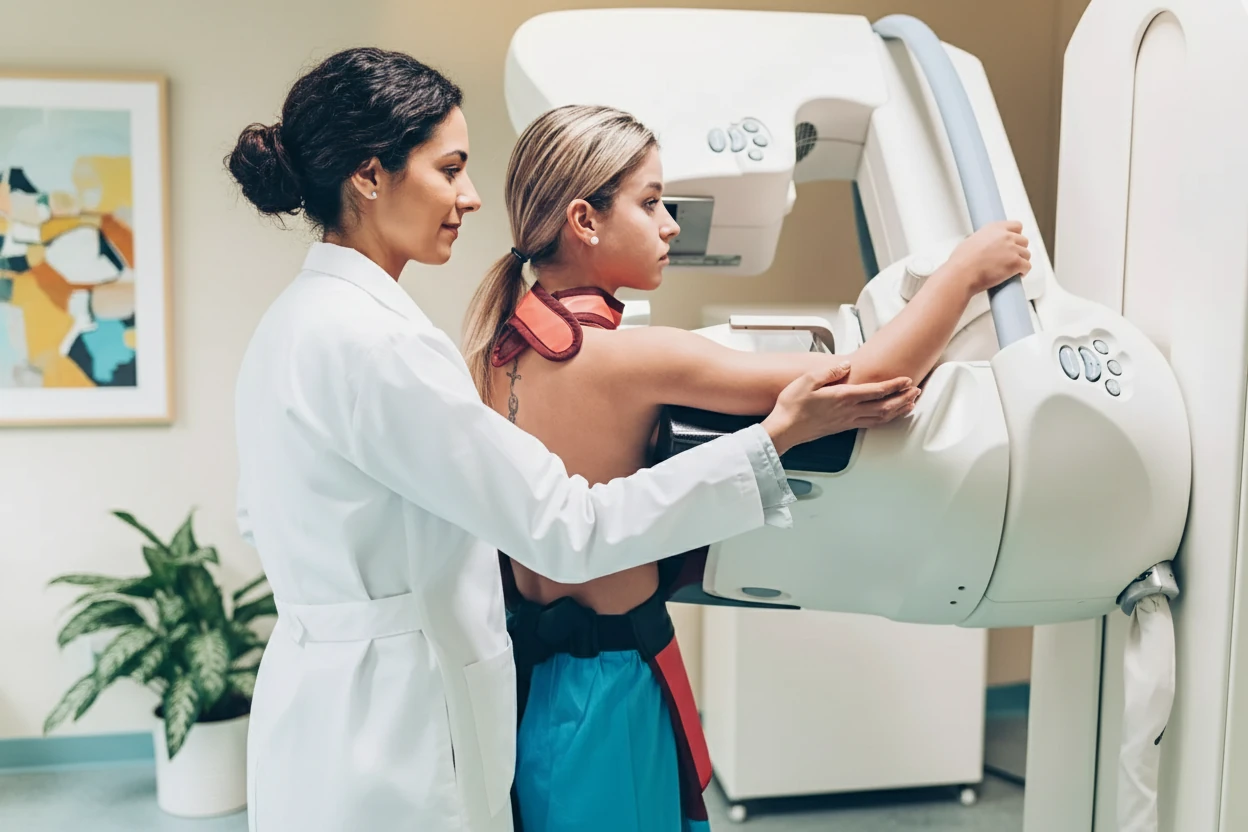
Breast density is a significant factor in breast cancer risk, with about half of women having dense breast tissue that can both increase cancer deaths risk and complicate detection1. Breast density is not static; it changes over time, often decreasing with age, but patterns of change vary among individuals and may influence cancer risk2. Understanding these changes, especially differences between individual breasts, can improve early detection and screening strategies3.
Breast Density Variations Between Breasts
Breast density refers to the proportion of fibroglandular (dense) tissue compared to fatty tissue in the breast. Dense tissue appears white on mammograms, which can mask tumors that also appear white, making cancer harder to detect1. While breast density typically decreases with age and menopause, recent research highlights important variations in how density changes between the two breasts of the same woman.
A longitudinal study of 947 women found that density changes are not always symmetrical between breasts3. Specifically, if one breast loses density more slowly than the other, that breast has a higher likelihood of developing cancer3. This asymmetry in density change may signal localized risk before tumors become visible on mammograms, offering a potential early warning sign3.
The biological reasons for asymmetric density changes remain unclear, but they may reflect underlying tissue differences or localized proliferative changes4. Recognizing these patterns could help radiologists and oncologists identify women at higher risk and tailor screening more effectively3.
💡 Did You Know? Breast density is one of the risk factors for breast cancer, and women with dense breast tissue have a higher risk of developing breast cancer14.
Breast density is influenced by several factors, including age, hormone levels, and body mass index (BMI). Younger women tend to have denser breasts, and density generally declines with age, especially after menopause5. However, some women experience little change or even increases in density over time, which is associated with higher breast cancer risk2.
A large population study identified five distinct trajectories of breast density change over time, with women who had persistently dense or increasing density facing greater breast cancer risk2. This supports the idea that monitoring density changes in each breast over time provides valuable risk information beyond a single measurement2.
- Breast density typically decreases with age but can change differently in each breast53.
- Slower density decline or increasing density in one breast may indicate higher cancer risk in that breast32.
- Asymmetric density changes could serve as early markers before tumors are detectable3.
- The biological mechanisms behind these asymmetries are not yet fully understood4.
- Monitoring longitudinal density changes improves risk stratification compared to single-time assessments2.
Enhanced Screening Guidelines
Breast density affects both cancer risk and the effectiveness of mammographic screening. Women with dense breasts have a modestly increased risk of breast cancer and experience reduced sensitivity of mammography due to the masking effect of dense tissue6. About 10% of women have extremely dense breasts, which doubles their breast cancer risk compared to those with non-dense breasts7.
Digital mammography, including 3D mammography (digital breast tomosynthesis), is the standard screening tool and offers improved visualization of dense tissue compared to traditional film mammography81. However, mammograms remain less sensitive in women with dense breasts, with sensitivity dropping from 93% in mostly fatty breasts to 73% in extremely dense breasts9.
Despite this, mammography is cost-effective and proven to reduce breast cancer mortality, making it the primary screening method for most women10. Radiologists traditionally focus on detecting new lesions rather than changes in breast density disappearance rates, but attention to slower-than-expected density reduction may help identify early cancer risk11.
Because dense breast tissue can obscure tumors, supplemental screening methods such as ultrasound, magnetic resonance imaging (MRI), and contrast-enhanced mammography (CEM) are considered, especially for women with additional risk factors107. Each modality has benefits and limitations:
- Ultrasound can detect some cancers missed by mammography but may increase false positives712.
- MRI improves cancer detection in extremely dense breasts but is costly and less available7.
- Contrast-enhanced mammography offers similar detection rates to MRI at lower costs but is less widely used7.
Currently, there is no consensus on routine supplemental screening for all women with dense breasts who are asymptomatic and have no additional risk factors6. The American College of Obstetricians and Gynecologists recommends compliance with state laws requiring disclosure of breast density but does not endorse routine use of adjunctive tests without clear evidence of improved outcomes6.
Recent studies suggest that incorporating longitudinal breast density changes into risk prediction models can improve personalized screening strategies1113. Women with persistently high or increasing density over time have a higher risk of breast cancer, supporting more tailored screening intervals and modalities2.
Breast density is classified into four BI-RADS categories:
“Breast density has been known to be associated with an increased risk of breast cancer diagnosis. What we wanted to do was go beyond that and determine the actual underlying risk of developing breast cancer, separate from the biases in screening.”
— Jane Lange, Ph.D., Oregon Health & Science University Knight Cancer Institute9
| Category | Description | Breast Tissue Composition | Screening Implications |
|---|---|---|---|
| A | Almost entirely fatty | Mostly fat, very little dense tissue | Low breast cancer risk; mammograms highly sensitive1 |
| B | Scattered fibroglandular densities | Mostly fat with some dense areas | Slightly increased risk; mammograms effective1 |
| C | Heterogeneously dense | More dense tissue, some fat | Moderate increased risk; mammograms less sensitive1 |
| D | Extremely dense | Almost all dense tissue | Highest risk; mammograms least sensitive17 |
As of September 2024, the FDA mandates that mammogram reports must include breast density information, informing women if they have dense breasts and advising discussion of risks and screening options91.
- Mammography remains the primary screening tool for all women, including those with dense breasts101.
- Women with dense breasts should be informed about their density and associated risks91.
- Supplemental screening (ultrasound, MRI, CEM) may be considered for women with dense breasts and additional risk factors107.
- Routine supplemental screening is not currently recommended for asymptomatic women without other risk factors6.
- Longitudinal monitoring of breast density changes can improve risk stratification and guide personalized screening112.