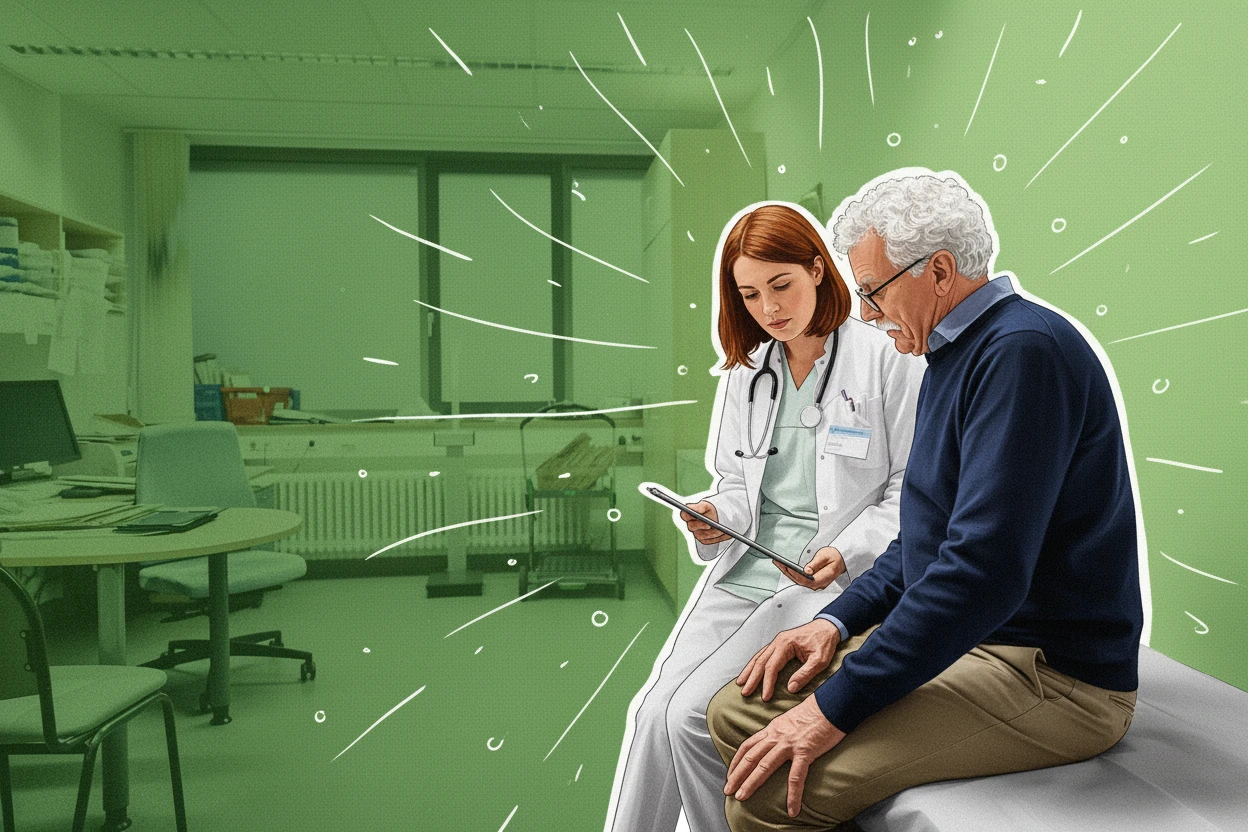
Parkinson's disease is the second most common neurodegenerative disorder worldwide, affecting millions of people and leading to progressive movement difficulties1. Diagnosing Parkinson's disease relies primarily on clinical evaluation, as there is no definitive laboratory or imaging test that can confirm the disease2. Early and accurate diagnosis is essential for managing symptoms and improving quality of life3.
Diagnostic Criteria for Parkinson's
The diagnosis of Parkinson's disease is primarily clinical, based on the recognition of characteristic motor features by a neurologist4. Parkinsonism is defined by the presence of bradykinesia (slowness of movement) plus at least one of the following: resting tremor, rigidity, or postural instability4. Bradykinesia is present in almost all cases and is usually the first symptom noticed4. Rigidity refers to increased muscle tone and resistance to passive movement, typically starting asymmetrically on one side4. Resting tremor is a hallmark feature, often worsening when the patient is at rest4. Postural instability, which leads to balance and coordination difficulties, usually appears in later stages of the disease4.
The most widely accepted diagnostic criteria come from the UK Parkinson’s Disease Society Brain Bank, which require bradykinesia plus at least one of muscular rigidity, 4–6 Hz resting tremor, or postural instability4. Despite these criteria, diagnostic accuracy remains challenging, with studies showing that up to 25% of clinical diagnoses may be incorrect upon postmortem examination5.
Supportive Symptoms and Red Flags
In addition to the cardinal motor signs, gait disturbances such as a shuffling walk with short, unsteady steps are common in Parkinson's disease4. Rigidity is usually asymmetric, beginning on one side and progressing to the other4. Postural instability is a key sign that typically emerges in advanced stages and significantly increases fall risk4. The presence of these features supports the diagnosis, while their absence or atypical presentation may suggest alternative diagnoses or Parkinsonian syndromes4.
Medical History Assessment
A thorough medical history is crucial in diagnosing Parkinson's disease4. Neurologists assess symptom patterns, risk factors, and comorbid conditions during the diagnostic process4. Family history is an important risk factor, as genetic predisposition can influence disease development4. Exposure to environmental toxins, such as pesticides, also increases the risk of Parkinson's disease4.
The diagnosis of Parkinson's disease is based on the presence of bradykinesia plus at least one of the following: muscular rigidity, 4–6 Hz resting tremor, postural instability4.
Non-motor symptoms, including sleep disturbances, psychiatric issues, and autonomic dysfunction, are increasingly recognized as significant in the diagnostic evaluation4. Medication history is essential to rule out drug-induced parkinsonism, as certain drugs can cause symptoms that mimic Parkinson's disease4. The severity and duration of cardinal motor symptoms are carefully evaluated to understand disease progression and guide diagnosis4.
- Family history of Parkinson's disease or related disorders4
- Exposure to pesticides or environmental toxins4
- Non-motor symptoms such as sleep problems and mood disorders4
- Medication review to exclude drug-induced parkinsonism4
- Assessment of comorbid medical conditions4
Neurological Examination
The neurological exam is fundamental for diagnosing Parkinson's disease and monitoring its progression4. It involves detailed observation and testing of motor function, including tremor, rigidity, gait, and postural stability4. Specific tests such as the pull test and repetitive movement tasks help confirm the diagnosis4.
“When during a follow-up visit we notice new worsening bradykinesia, tremor or rigidity, this does not necessarily imply that a change in the medication regimen is needed, unless it is significantly impacting the quality of life of the patient. On the other hand, even the slightest impairment of gait and balance control necessitates an intervention, that may be as simple as physical therapy.”
— Stanford Medicine 256
Key components of the neurological exam include:
- Observation of resting tremor by having the patient sit with hands relaxed4
- Testing rigidity by passively moving the patient's limbs and assessing resistance4
- Assessing gait by observing walking patterns, including step length and arm swing4
- Evaluating postural instability through the pull test, which involves gently pulling the patient backward to assess balance4
- Performing repetitive movement tests to detect bradykinesia, such as finger tapping and rapid alternating movements6
Bradykinesia is identified by a reduction in the speed and amplitude of repetitive movements over time6. Rigidity is characterized by uniform resistance to passive movement, not dependent on movement direction or speed6. The pull test is positive if the patient requires more than two steps to regain balance or cannot stabilize, indicating impaired postural reflexes6.
Genetic Testing Options
Genetic testing is not routinely used in the diagnosis of Parkinson's disease4. It is reserved for cases with a strong family history or atypical presentations, such as early-onset Parkinson's disease4. Mutations in genes like SNCA, PRKN, and PINK1 are associated with familial forms of Parkinson's disease4. However, genetic testing does not currently play a major role in standard diagnostic protocols4.
Screening for Related Disorders
Differential diagnosis is critical because several conditions can mimic Parkinson's disease4. Drug-induced parkinsonism is a common cause of Parkinsonian symptoms and must be excluded through medication history4. Other neurological disorders with overlapping features include corticobasal degeneration, dementia with Lewy bodies, essential tremor, Fahr syndrome, and multiple system atrophy4.
Essential tremor differs from Parkinson's disease in that it is typically an action-induced tremor, usually bilateral, and lacks other Parkinsonian features4. Advanced Parkinson's disease can present with dementia-symptoms-causes-and-treatmentdementia-stages-symptoms-and-progression-explaineddementia and hallucinations, which may overlap with dementia with Lewy bodies4. Imaging and laboratory tests, such as MRI and dopamine transporter scans (DaTscan), help exclude other causes but are not definitive for Parkinson's disease4.
- Drug-induced parkinsonism4
- Corticobasal degeneration4
- Dementia with Lewy bodies4
- Essential tremor (action-induced, bilateral)4
- Multiple system atrophy and Fahr syndrome4
| Diagnostic Component | Purpose | Notes |
|---|---|---|
| Clinical motor features | Identify bradykinesia plus tremor, rigidity, or postural instability4 | Essential for diagnosis |
| Medical history | Assess risk factors, symptom patterns, medication use4 | Helps exclude mimics |
| Neurological exam | Evaluate motor signs and balance46 | Includes pull test and repetitive movement tests |
| DaTscan imaging | Visualize dopamine transporter activity2 | Supports diagnosis, not definitive |
| Medication response | Assess symptom improvement with dopaminergic drugs3 | Positive response supports diagnosis |
💡 Did You Know?
Parkinson's disease diagnosis can take time, often requiring multiple visits and follow-up to confirm symptom progression and treatment response7.
Parkinson's Diagnosis Summary
Parkinson's disease diagnosis is a clinical process centered on identifying cardinal motor symptoms, supported by a detailed medical history and neurological examination4. There is no single test to confirm Parkinson's disease, but imaging and laboratory tests can help rule out other conditions4. The DaTscan is an imaging tool that visualizes the brain's dopamine system and can support diagnosis when clinical features are unclear2. However, it cannot distinguish Parkinson's disease from other Parkinsonian syndromes with dopamine loss2.
Response to dopaminergic medications also aids diagnosis; improvement in symptoms such as bradykinesia and rigidity supports Parkinson's disease3. Follow-up evaluations are important to monitor disease progression and treatment response7.